
Meta Title: Latest Technology Trends in 2026 | Top Emerging Technologies
Meta Description: Explore the latest technology trends in 2026, including artificial intelligence, robotics, quantum computing, cybersecurity, cloud computing, IoT, blockchain, and more.
Focus Keyword: Latest Technology Trends in 2026
URL Slug: latest-technology-trends-2026
Latest Technology Trends in 2026
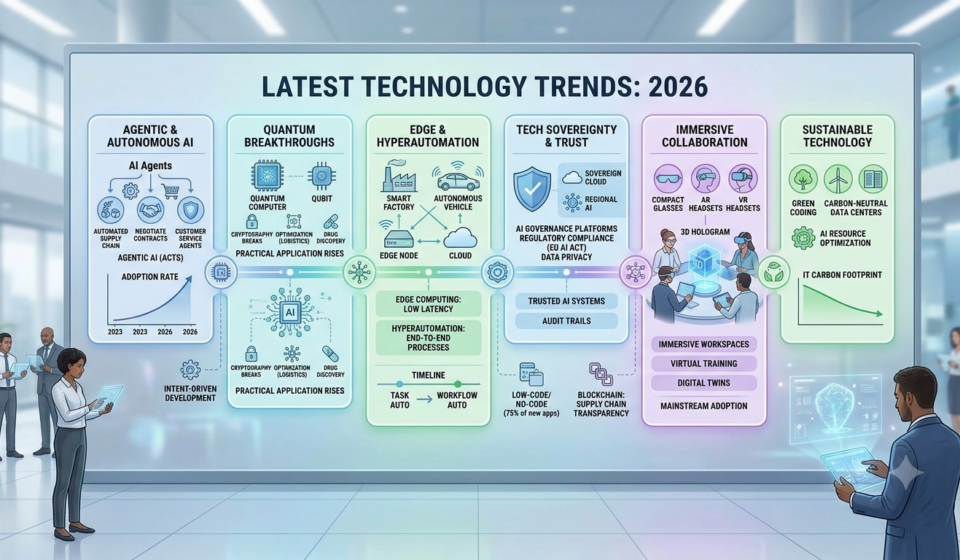
Technology continues to evolve at an extraordinary pace, transforming industries, businesses, and everyday life. In 2026, innovations in artificial intelligence, cloud computing, cybersecurity, robotics, and next-generation connectivity are reshaping how people work, communicate, learn, and interact with digital systems.
Organizations across every sector are investing in emerging technologies to improve efficiency, reduce costs, enhance customer experiences, and gain a competitive advantage. At the same time, consumers are benefiting from smarter devices, faster internet, improved healthcare solutions, and more personalized digital services.
This comprehensive guide explores the latest technology trends in 2026, explains their real-world applications, discusses their advantages and challenges, and highlights how these innovations are expected to shape the future.
Why Technology Trends Matter
Keeping up with technology trends is essential for businesses, professionals, students, and entrepreneurs. New technologies influence economic growth, job opportunities, cybersecurity, education, healthcare, and digital transformation.
Understanding emerging technologies helps organizations:
- Improve productivity
- Reduce operational costs
- Enhance customer satisfaction
- Strengthen cybersecurity
- Increase innovation
- Make better business decisions
- Stay competitive in rapidly changing markets
For individuals, staying informed supports career development and helps build valuable technical skills.
1. Artificial Intelligence (AI)
Artificial Intelligence remains one of the most influential technologies of 2026. AI systems are becoming more capable of understanding language, analyzing images, generating content, automating workflows, and assisting with decision-making.
Businesses are integrating AI into customer support, software development, healthcare, finance, education, manufacturing, and marketing.
Common Applications
- AI assistants
- Content creation
- Customer service chatbots
- Medical diagnosis support
- Fraud detection
- Language translation
- Data analysis
- Personalized recommendations
Benefits
- Increased productivity
- Better decision-making
- Faster automation
- Improved customer experiences
2. Generative AI
Generative AI has transformed content creation by producing text, images, videos, music, presentations, and software code from simple prompts.
Organizations use generative AI to accelerate creative workflows while maintaining human oversight for quality and accuracy.
Popular applications include:
- Article writing
- Graphic design
- Video generation
- Marketing campaigns
- Programming assistance
- Product descriptions
- Educational materials
Generative AI continues to expand into more industries as models become increasingly capable.
3. Cybersecurity and AI-Powered Defense
As cyber threats become more sophisticated, cybersecurity remains one of the fastest-growing technology sectors.
Modern security platforms now use AI to detect suspicious activity, identify malware, respond to attacks, and analyze enormous volumes of security data in real time.
Key developments include:
- AI threat detection
- Zero Trust security
- Behavioral analytics
- Identity protection
- Cloud security
- Endpoint detection and response (EDR)
Organizations are investing heavily in cybersecurity to protect digital infrastructure and customer data.
4. Cloud Computing
Cloud computing continues to support digital transformation across businesses of all sizes.
Instead of relying entirely on physical infrastructure, organizations increasingly use cloud platforms to host applications, store data, and scale services efficiently.
Benefits include:
- Flexible computing resources
- Reduced infrastructure costs
- Improved collaboration
- Disaster recovery
- Remote accessibility
Hybrid and multi-cloud strategies remain popular for balancing performance, resilience, and compliance.
5. Edge Computing
Edge computing processes data closer to where it is generated instead of sending everything to centralized cloud servers.
This reduces latency and improves performance for applications requiring near real-time responses.
Common uses include:
- Smart factories
- Autonomous vehicles
- Industrial automation
- Healthcare monitoring
- Smart cities
Edge computing complements cloud services by improving speed and reliability.
6. Internet of Things (IoT)
The Internet of Things continues expanding as billions of connected devices communicate and exchange information.
IoT applications include:
- Smart homes
- Wearable health devices
- Connected vehicles
- Industrial monitoring
- Precision agriculture
- Energy management
Organizations use IoT to improve efficiency, reduce downtime, and collect valuable operational insights.
7. Robotics and Intelligent Automation
Robotics technology has become more capable through advances in AI, sensors, and machine vision.
Modern robots assist with:
- Manufacturing
- Warehousing
- Healthcare
- Agriculture
- Logistics
- Hospitality
Collaborative robots, often called cobots, are designed to safely work alongside human employees, improving productivity without replacing every manual task.
8. Quantum Computing
Quantum computing remains an emerging technology with the potential to solve highly complex problems beyond the capabilities of traditional computers.
Although practical large-scale adoption is still developing, research continues in areas such as:
- Drug discovery
- Material science
- Financial modeling
- Cryptography
- Scientific simulations
Quantum technologies are expected to influence numerous industries over the coming decade.
9. Blockchain Technology
Blockchain continues evolving beyond cryptocurrency applications.
Businesses now use blockchain for:
- Supply chain transparency
- Digital identity
- Smart contracts
- Asset tracking
- Financial transactions
- Document verification
Its decentralized architecture improves transparency and reduces opportunities for unauthorized data modification.
10. 5G and Advanced Connectivity
High-speed wireless connectivity continues expanding through widespread 5G deployment.
Benefits include:
- Faster download speeds
- Lower network latency
- Improved mobile experiences
- Enhanced IoT connectivity
- Better remote collaboration
- Support for smart infrastructure
Reliable high-speed connectivity enables many other emerging technologies to operate effectively.
11. Extended Reality (XR)
Extended Reality combines Virtual Reality (VR), Augmented Reality (AR), and Mixed Reality (MR) to create immersive digital experiences.
Applications include:
- Employee training
- Education
- Healthcare simulations
- Retail visualization
- Engineering design
- Entertainment
XR technologies continue becoming more practical as hardware improves.
12. Sustainable Technology
Environmental sustainability has become an important focus for technology companies.
Organizations are investing in:
- Energy-efficient data centers
- Renewable energy
- Carbon monitoring
- Smart power management
- Green manufacturing
- Sustainable packaging
Technology is increasingly used to reduce environmental impact while supporting long-term business growth.
How Businesses Benefit from Emerging Technologies
Companies adopting modern technologies often experience measurable improvements.
Improved Productivity
Automation reduces repetitive work and allows employees to focus on higher-value activities.
Better Customer Experiences
AI-powered personalization and digital services create more engaging customer interactions.
Increased Efficiency
Cloud computing, analytics, and automation streamline operations.
Enhanced Security
Modern cybersecurity solutions improve threat detection and incident response.
Greater Innovation
Emerging technologies enable businesses to develop new products, services, and business models.
Challenges of Adopting New Technologies
Despite their advantages, emerging technologies also present challenges.
Cybersecurity Risks
As systems become more connected, organizations must strengthen security measures.
Skills Shortages
Demand for professionals with expertise in AI, cybersecurity, cloud computing, and data science continues to grow.
Privacy Concerns
Businesses must manage customer information responsibly and comply with data protection regulations.
Implementation Costs
Adopting advanced technologies often requires investment in infrastructure, software, and employee training.
Future Outlook
Technology innovation shows no signs of slowing down. Over the next several years, experts expect continued progress in AI, robotics, quantum computing, biotechnology, cybersecurity, and advanced connectivity.
Businesses that remain adaptable, invest in employee education, and responsibly adopt emerging technologies will be better positioned for long-term success.
Individuals who continuously learn new technical skills are also likely to benefit from expanding career opportunities in the digital economy.
Frequently Asked Questions
What is the biggest technology trend in 2026?
Artificial Intelligence, particularly generative AI, continues to be one of the most influential technology trends because of its widespread use in automation, content creation, software development, customer service, and business decision-making.
Why is cybersecurity becoming more important?
As organizations rely more heavily on digital infrastructure and connected devices, protecting systems, data, and customer information has become essential for reducing cyber risks.
Is cloud computing still growing?
Yes. Businesses continue adopting cloud services to improve flexibility, scalability, collaboration, and disaster recovery while reducing infrastructure costs.
Which technology skills are in high demand?
Skills in Artificial Intelligence, cybersecurity, cloud computing, software development, data science, machine learning, DevOps, and networking remain highly valuable across many industries.
Conclusion
The latest technology trends in 2026 demonstrate how rapidly innovation is transforming the digital world. Artificial Intelligence, generative AI, cybersecurity, cloud computing, IoT, robotics, blockchain, quantum computing, and advanced connectivity are driving significant changes across industries and everyday life.
Organizations that embrace these technologies responsibly can improve efficiency, strengthen security, create better customer experiences, and unlock new opportunities for innovation. At the same time, individuals who continue learning and adapting to technological advancements will be better prepared for future careers in an increasingly digital economy.
Technology will continue to evolve, but the organizations and professionals who combine innovation with responsible implementation, strong cybersecurity, and continuous learning will be best positioned to thrive in the years ahead.