
Meta Title: Internet of Things (IoT) Applications | Complete Guide 2026
Meta Description: Discover the top Internet of Things (IoT) applications in 2026. Learn how IoT is transforming smart homes, healthcare, agriculture, manufacturing, transportation, and modern businesses.
Focus Keyword: Internet of Things (IoT) Applications
URL Slug: internet-of-things-iot-applications
Internet of Things (IoT) Applications
The Internet of Things (IoT) has become one of the most influential technologies of the digital age. From smart homes and wearable fitness devices to connected factories and intelligent transportation systems, IoT is transforming the way people live, work, and interact with technology.
Every day, billions of connected devices collect, exchange, and analyze data without requiring constant human intervention. These devices help improve efficiency, automate routine tasks, reduce costs, and provide valuable insights for businesses and consumers alike.
As wireless connectivity, cloud computing, artificial intelligence, and edge computing continue to evolve, IoT applications are becoming more advanced and are driving digital transformation across nearly every industry.
This comprehensive guide explains what the Internet of Things is, how it works, its major applications, benefits, challenges, and future trends.
What Is the Internet of Things (IoT)?
The Internet of Things (IoT) refers to a network of physical devices connected to the internet that can collect, transmit, and process data. These devices contain sensors, processors, software, and communication technologies that enable them to interact with other devices and cloud platforms.
Examples of IoT devices include:
- Smart thermostats
- Security cameras
- Smartwatches
- Connected vehicles
- Industrial sensors
- Smart lighting systems
- Fitness trackers
- Medical monitoring devices
Rather than operating independently, IoT devices communicate continuously to improve efficiency and automate decision-making.
How IoT Works
An IoT system generally follows four basic steps:
1. Data Collection
Sensors installed in devices collect information such as temperature, motion, humidity, location, pressure, or energy consumption.
2. Data Transmission
The collected information is securely transmitted through Wi-Fi, Bluetooth, 5G, Ethernet, Zigbee, LoRaWAN, or other communication technologies.
3. Data Processing
Cloud platforms or edge computing systems analyze the incoming data using software, analytics, or artificial intelligence.
4. Action and Automation
Based on the processed information, the system performs predefined actions or provides recommendations to users.
For example, a smart thermostat automatically adjusts room temperature based on occupancy and weather conditions.
Why IoT Is Important
IoT enables organizations to make better decisions using real-time information.
Its importance continues to grow because it helps:
- Improve efficiency
- Reduce operational costs
- Increase automation
- Enhance customer experiences
- Optimize resource usage
- Improve safety
- Enable predictive maintenance
- Support digital transformation
Businesses across every major industry are adopting IoT to improve operations and remain competitive.
Major Applications of IoT
1. Smart Homes
Smart home technology is one of the most widely recognized IoT applications.
Connected devices allow homeowners to monitor and control household systems remotely using smartphones or voice assistants.
Examples include:
- Smart lighting
- Smart thermostats
- Smart locks
- Security cameras
- Video doorbells
- Smart speakers
- Smoke detectors
- Smart appliances
Benefits
- Improved convenience
- Lower energy consumption
- Better home security
- Remote monitoring
2. Healthcare
IoT has significantly improved healthcare by enabling continuous patient monitoring and faster access to medical information.
Healthcare IoT applications include:
- Wearable fitness trackers
- Remote patient monitoring
- Smart insulin pumps
- Heart rate monitoring
- Connected medical equipment
- Medication reminders
- Telemedicine support
Benefits
- Better patient care
- Early disease detection
- Reduced hospital visits
- Improved healthcare efficiency
3. Industrial IoT (IIoT)
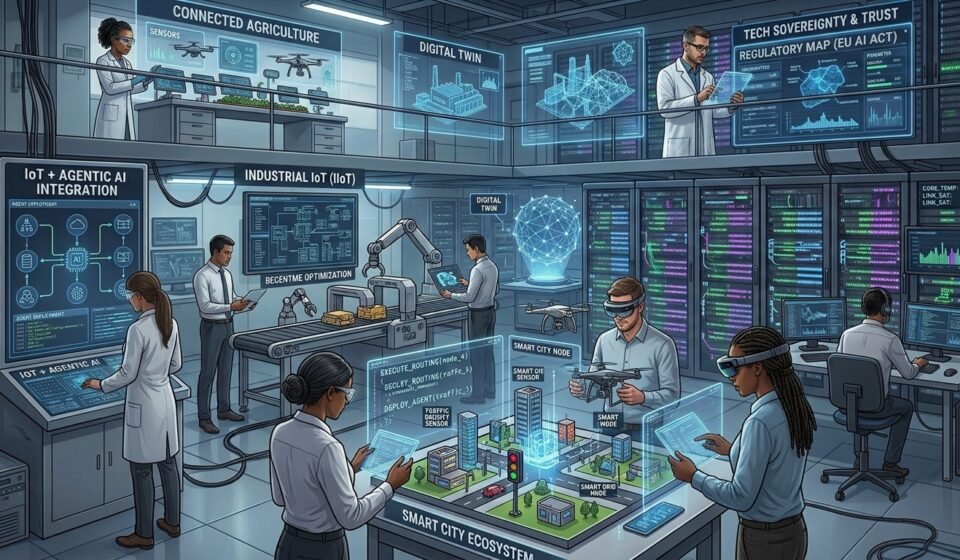
Industrial IoT connects machines, sensors, and production equipment to improve manufacturing operations.
Manufacturers use IoT for:
- Equipment monitoring
- Predictive maintenance
- Quality control
- Inventory management
- Energy optimization
- Production automation
Benefits
- Reduced downtime
- Higher productivity
- Improved product quality
- Lower maintenance costs
4. Smart Cities
Governments are using IoT technologies to create safer, cleaner, and more efficient cities.
Applications include:
- Intelligent traffic management
- Smart street lighting
- Waste management
- Environmental monitoring
- Water management
- Public transportation systems
- Parking management
Smart city initiatives improve resource utilization while enhancing residents’ quality of life.
5. Agriculture
Modern agriculture increasingly depends on IoT to improve crop production and resource management.
Common agricultural applications include:
- Soil moisture sensors
- Weather monitoring
- Smart irrigation
- Livestock tracking
- Crop monitoring
- Drone-assisted farming
- Greenhouse automation
Benefits
- Higher crop yields
- Water conservation
- Lower operating costs
- Better farm management
6. Transportation and Logistics
IoT improves transportation by providing real-time tracking and operational visibility.
Applications include:
- Fleet management
- Vehicle diagnostics
- GPS tracking
- Fuel monitoring
- Route optimization
- Cargo monitoring
- Predictive vehicle maintenance
These technologies improve delivery efficiency while reducing transportation costs.
7. Retail
Retail businesses use IoT to improve inventory management and customer experiences.
Examples include:
- Smart shelves
- Automated inventory tracking
- Customer behavior analysis
- Contactless payments
- Personalized shopping experiences
- Smart checkout systems
Retailers gain better visibility into inventory while improving operational efficiency.
8. Energy Management
Utility companies and businesses use IoT to optimize energy usage.
Applications include:
- Smart electricity meters
- Smart grids
- Building automation
- Energy monitoring
- Renewable energy management
IoT supports sustainability by reducing unnecessary energy consumption.
9. Environmental Monitoring
Environmental organizations use IoT sensors to monitor changing conditions.
Examples include:
- Air quality monitoring
- Water quality analysis
- Forest monitoring
- Flood detection
- Weather observation
- Wildlife tracking
These systems provide valuable information for environmental protection and disaster preparedness.
10. Education
Educational institutions use IoT to improve campus management and learning environments.
Applications include:
- Smart classrooms
- Attendance systems
- Interactive learning devices
- Campus security
- Asset tracking
- Energy management
IoT helps schools operate more efficiently while improving the learning experience.
Benefits of IoT Applications
Organizations implementing IoT often experience several advantages.
Improved Efficiency
Automation reduces manual work and increases productivity.
Better Decision-Making
Real-time data enables faster and more informed decisions.
Cost Savings
Predictive maintenance and optimized resource usage reduce operational expenses.
Enhanced Customer Experience
Connected services provide more personalized and responsive customer interactions.
Increased Safety
IoT systems monitor equipment, infrastructure, and environments to identify potential risks early.
Greater Sustainability
Efficient use of energy, water, and other resources supports environmental sustainability.
Challenges of IoT
Despite its benefits, IoT also presents challenges.
Cybersecurity
Connected devices can become targets for cyberattacks if they are not properly secured.
Privacy
IoT devices often collect sensitive personal and operational data.
Organizations must manage this information responsibly.
Device Compatibility
Different manufacturers may use different communication standards, making integration more complex.
Data Management
Billions of connected devices generate enormous amounts of data that require efficient storage and analysis.
Maintenance
Keeping IoT devices updated and secure requires continuous monitoring and software updates.
IoT Security Best Practices
Organizations should adopt strong security measures to protect connected devices.
Recommended practices include:
- Change default passwords immediately.
- Enable multi-factor authentication where available.
- Keep device firmware updated.
- Encrypt sensitive data.
- Secure wireless networks.
- Monitor connected devices regularly.
- Limit unnecessary device access.
- Remove unsupported or outdated devices from the network.
Security should be considered throughout the entire lifecycle of every IoT deployment.
Future of IoT
The Internet of Things will continue expanding as technologies such as artificial intelligence, 5G, cloud computing, and edge computing mature.
Future developments are expected to include:
- AI-powered automation
- Smarter autonomous vehicles
- More connected healthcare systems
- Advanced industrial automation
- Intelligent supply chains
- Expanded smart city infrastructure
- Sustainable energy management
- Improved predictive analytics
As connectivity improves, IoT will become even more deeply integrated into everyday life and business operations.
Frequently Asked Questions
What is the Internet of Things (IoT)?
The Internet of Things is a network of connected physical devices that collect, share, and process data through the internet to automate tasks and improve decision-making.
What are the most common IoT applications?
Popular IoT applications include smart homes, healthcare, manufacturing, agriculture, transportation, retail, smart cities, environmental monitoring, and energy management.
Is IoT secure?
IoT can be secure when devices are properly configured, regularly updated, protected with strong authentication, and monitored for unusual activity. Security should always be a priority when deploying connected devices.
How does IoT benefit businesses?
IoT helps businesses improve efficiency, reduce operational costs, monitor equipment in real time, automate workflows, optimize resource usage, and make data-driven decisions.
Conclusion
The Internet of Things has transformed how people and organizations interact with technology by connecting physical devices to digital networks. From smart homes and healthcare to manufacturing, agriculture, transportation, and environmental monitoring, IoT applications are improving efficiency, enabling automation, and generating valuable real-time insights.
Although challenges such as cybersecurity, privacy, and device management remain important considerations, the benefits of IoT continue to drive widespread adoption across industries. As technologies like artificial intelligence, 5G, and edge computing advance, IoT will play an even greater role in shaping the future of connected living, intelligent business operations, and sustainable innovation.